
AI Is Moving Faster Than Governance. That’s a Leadership Problem.
What my CCDO journey is teaching me about ownership, accountability, and making better decisions in the age of AI.

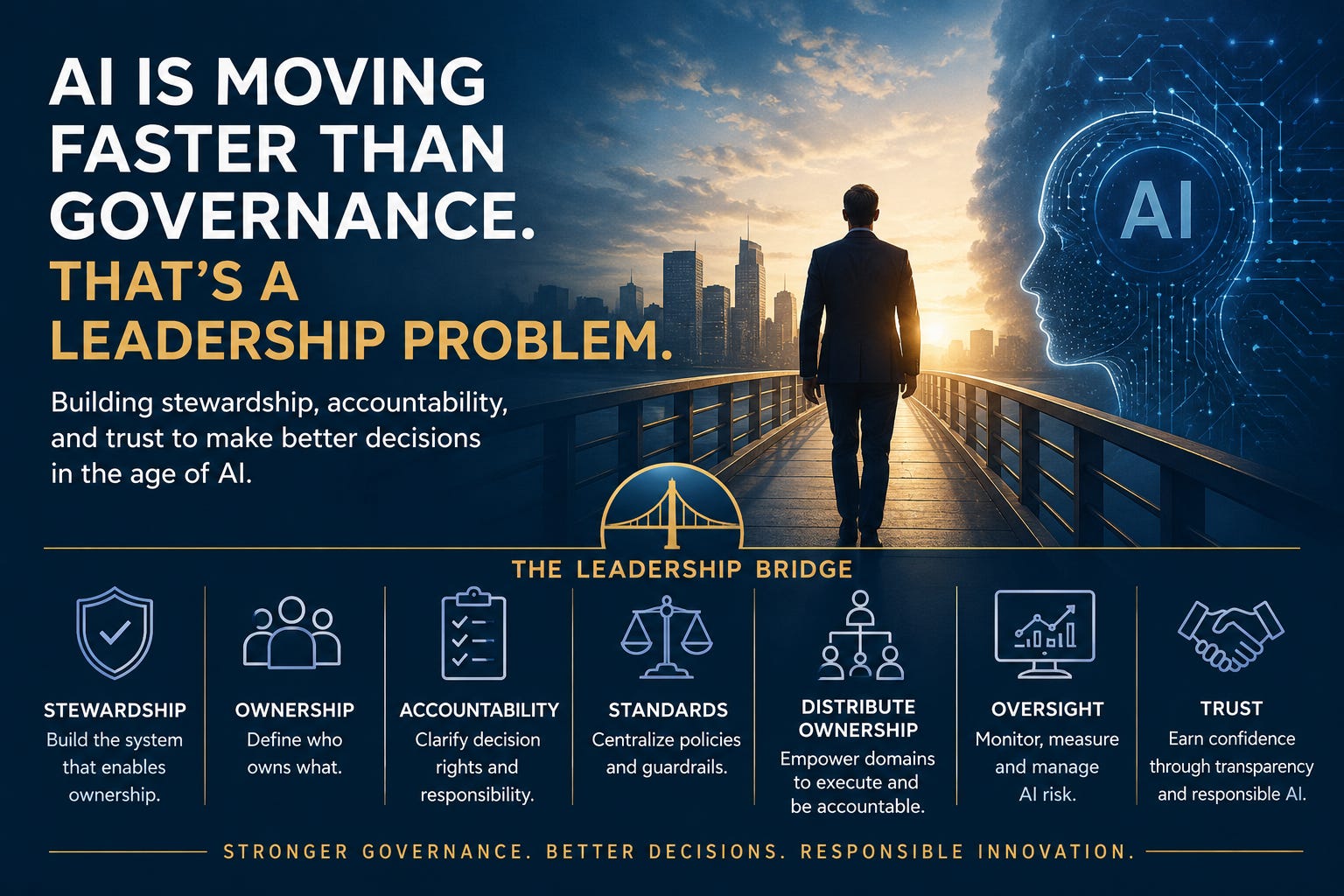
As I work through the Chief Data Officer (CCDO) Certification Program, I have been challenging some of my own thinking about data, AI, governance, and leadership.
The technology is fascinating, but I keep finding myself drilling down on more fundamental questions:
Who owns what?
Who is ultimately accountable?
Where should decisions be made?
And as a leader, how do I use the right information, governance structures, and perspectives to make better decisions in my own role?
Those questions extend far beyond the office of a Chief Data Officer.
Organizations everywhere are thinking about how to adopt AI. But there is another question that deserves just as much attention:
Who is accountable when AI gets it wrong?
The more I study this space, the more convinced I become that one of the biggest challenges ahead may not be the technology itself.
It may be leadership.
Who Actually Owns What?
One concept from my CCDO coursework has particularly challenged my thinking:
The Chief Data Officer does not simply “own the data.” The CDO owns the stewardship system.
That distinction matters.
A CDO cannot—and should not—personally own every piece of organizational data or every decision involving it.
Instead, leadership establishes the structure that makes responsible ownership possible.
The coursework distinguishes among data owners, data stewards, and custodians, with defined decision rights and escalation paths. It also emphasizes that stewardship should sit within the business rather than being treated only as an IT responsibility.
That has made me think differently about leadership itself.
Sometimes leadership is less about owning every decision and more about making sure everyone understands which decisions they own.
From Data Governance to AI Governance
Traditional data governance focuses on areas such as data quality, consistency, security, accessibility, stewardship, classification, and controls.
AI governance extends that responsibility.
Now organizations must also think about model explainability, bias, algorithmic fairness, legal compliance, model outputs, and the broader ethical consequences of AI-supported decisions.
The progression in the coursework is straightforward but significant:
Data → Data + Models + Outputs.
That means accountability has to evolve too.
Leaders must increasingly ask:
Is the underlying data trustworthy?
Can we explain how an AI-supported decision was reached?
Could the system introduce or amplify bias?
Where should human judgment remain in the process?
And who is accountable for the outcome?
These are not simply technology questions.
They are leadership questions.
Centralize Standards. Distribute Ownership.
Another idea I have been thinking through is federated governance.
The enterprise establishes shared policies, standards, risk expectations, compliance requirements, and governance principles.
But execution, quality, and business accountability remain within individual domains.
The leadership principle I take from that is simple:
Centralize the standards. Distribute the ownership.
One executive, technology team, or governance committee cannot responsibly own every AI decision across an organization.
Finance has responsibilities.
Human Resources has responsibilities.
Operations has responsibilities.
Technology, legal, security, compliance, risk, and business leadership all have roles to play.
Consider something as practical as an HR organization using AI to support candidate screening.
Technology may secure the system.
Data teams may help establish data-quality and lineage standards.
Legal and compliance may help establish appropriate controls.
But HR leadership still has responsibility for how that process affects people and employment decisions.
Someone must ultimately own the outcome.
Governance Should Improve Decision-Making
This coursework is also causing me to think more deeply about my own leadership.
Governance can sound bureaucratic.
At its best, however, governance helps leaders answer very practical questions:
What information should I trust?
Who needs to be involved?
Who has authority to make this decision?
What risks need to be considered?
What should be escalated?
Who is accountable for the outcome?
Those questions matter whether someone is leading a corporation, nonprofit, educational institution, or government organization.
Good governance should not remove judgment from leadership.
It should help leaders exercise better judgment.
Governance Should Enable Innovation
Governance should also not simply become another mechanism for saying no.
Done well, it creates greater confidence to move.
Without clear boundaries, organizations can easily fall into one of two extremes: moving quickly without understanding the risks or becoming so concerned about risk that meaningful innovation slows down.
Clear guardrails provide another path.
The coursework describes AI governance controls including bias detection, explainability requirements, human-in-the-loop controls, and prompt and output controls for generative AI.
The goal is not governance for governance’s sake.
It is creating an environment where people understand what they can do, where additional oversight is necessary, and who owns the decision.
That is how innovation and accountability can coexist.
This Is Ultimately About Trust
One of the ideas that stayed with me most from this module is that the CDO does not necessarily “own AI risk.”
Rather, the CDO helps establish the governance system that makes AI risk visible, manageable, and accountable.
That distinction goes far beyond the role of the CDO.
It speaks to leadership.
As I continue through the CCDO program, I expect some of my thinking to continue evolving.
That is part of the value for me.
I am not simply trying to understand another framework or another technology.
I am trying to become more disciplined about asking:
Who owns what?
Where does accountability sit?
What information should inform the decision?
And how can I make better decisions as a leader?
AI makes those questions increasingly important.
Organizations will certainly need strong technology.
But technology alone will not be enough.
They will need stewardship.
They will need accountability.
They will need transparency.
And they will need leaders capable of building systems where innovation and responsibility can exist together.
In many organizations, AI is already becoming part of how work gets done.
The more important question is whether we will build the governance, stewardship, and trust necessary to use it well.
That isn’t simply an IT question.
It’s a leadership question.
As I continue through the CCDO program, I am grateful for the opportunity to challenge and refine my thinking around data, AI, governance, and leadership—and for Dr. Richard Wang and the broader CDO community helping advance these conversations.