

By Bus Obayomi
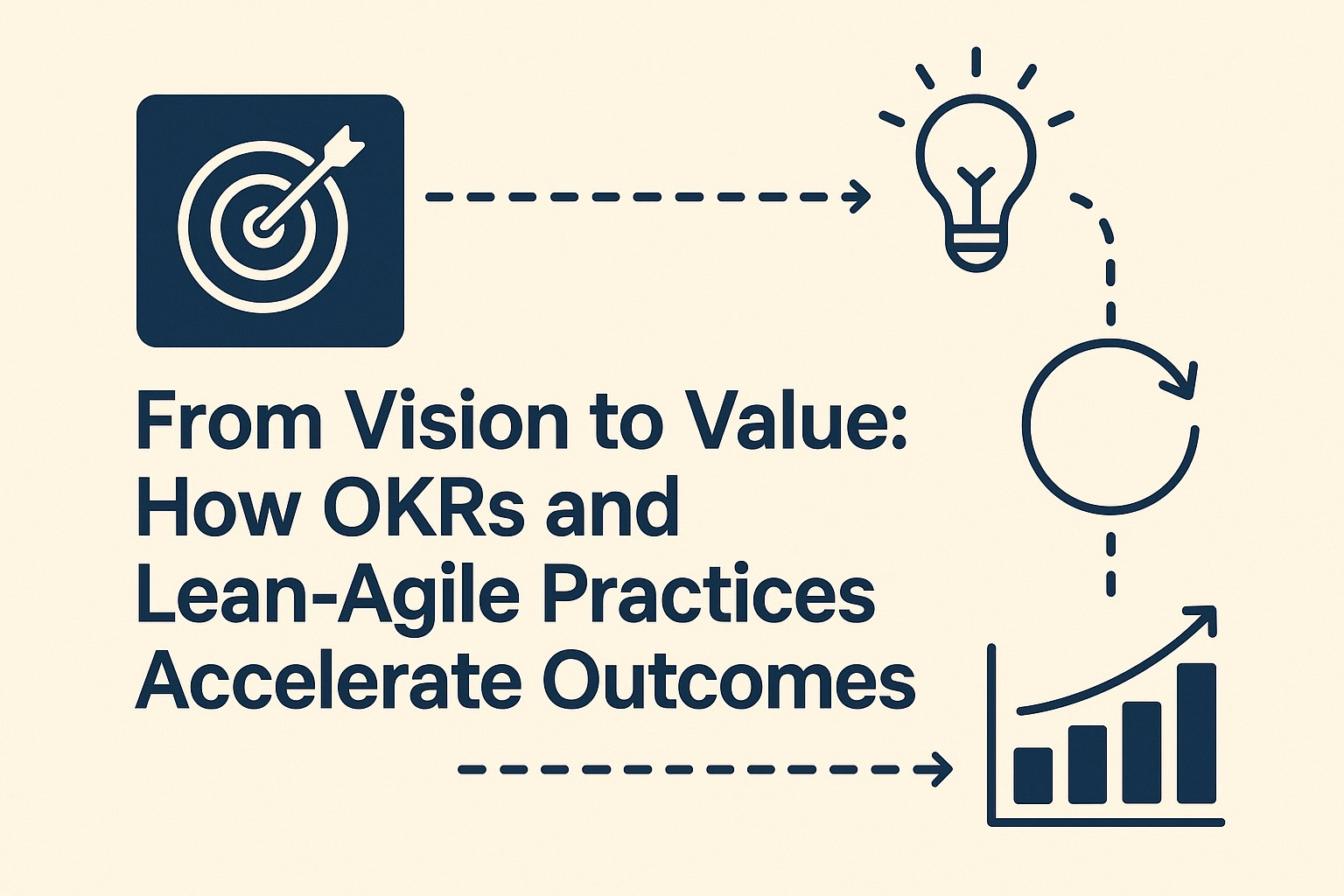
In today’s fast-paced environment, leaders are being asked to deliver clarity, speed, and measurable impact — all at once. It’s no longer enough to simply “do Agile.” It’s about aligning work with what truly matters and accelerating the path from intent to impact. That’s where Objectives and Key Results (OKRs), when paired with Lean-Agile practices, become transformative.
The Power of Alignment
OKRs help teams answer the question: “What are we trying to achieve, and how will we know we’re making progress?” They are not just goal-setting tools — they’re alignment accelerators. In large organizations or public sector environments where initiatives can easily sprawl, OKRs create focus. They clarify why we’re doing what we’re doing.
In Lean-Agile settings, this alignment becomes even more critical. Agile teams can move fast, but without a shared north star, speed can turn into noise. OKRs ensure that velocity is value-driven, not vanity-driven.
Lean-Agile = Fast Feedback + Empowered Teams
The Lean-Agile mindset emphasizes flow, feedback, and learning. When combined with OKRs, it becomes a flywheel of continuous alignment:
Set the vision (Objective)
Define measurable progress (Key Results)
Organize value streams and teams around delivering outcomes
Inspect, adapt, and refine based on feedback
Instead of planning for perfection, we pursue purpose. We build in small increments, measure impact quickly, and shift when necessary.
What This Looks Like in Practice
Here’s how I’ve seen this play out across engagements:
In government: OKRs helped cross-functional teams rally around citizen outcomes (like reduced processing time or improved service accessibility), not just task completion.
In commercial data transformation efforts: Agile cadences brought momentum, but OKRs ensured data quality, AI-readiness, and business value were front and center — not just tech delivery.
At the team level: OKRs became more than reporting mechanisms; they became daily decision-making tools, helping teams say no to distractions and yes to value.
What Leaders Must Do
As leaders, we don’t just introduce OKRs and Agile — we model them. We make sure OKRs aren’t hidden in slide decks but alive in team syncs and planning conversations. We make sure Agile isn’t just a process, but a posture.
Final Thought
When done right, OKRs and Lean-Agile practices don’t just help us do more. They help us do what matters. They keep our eyes on the mission, our feet moving in rhythm, and our hearts anchored in purpose.
As we face new challenges — from emerging technologies to evolving citizen and customer needs — let’s not default to noise. Let’s build with intention. Let’s lead with clarity.
What’s Next?
In my next post, I’ll share practical ways to introduce OKRs into Agile team settings — especially in complex or siloed organizations. Stay tuned.