

Turning complex transitions into strategic victories.
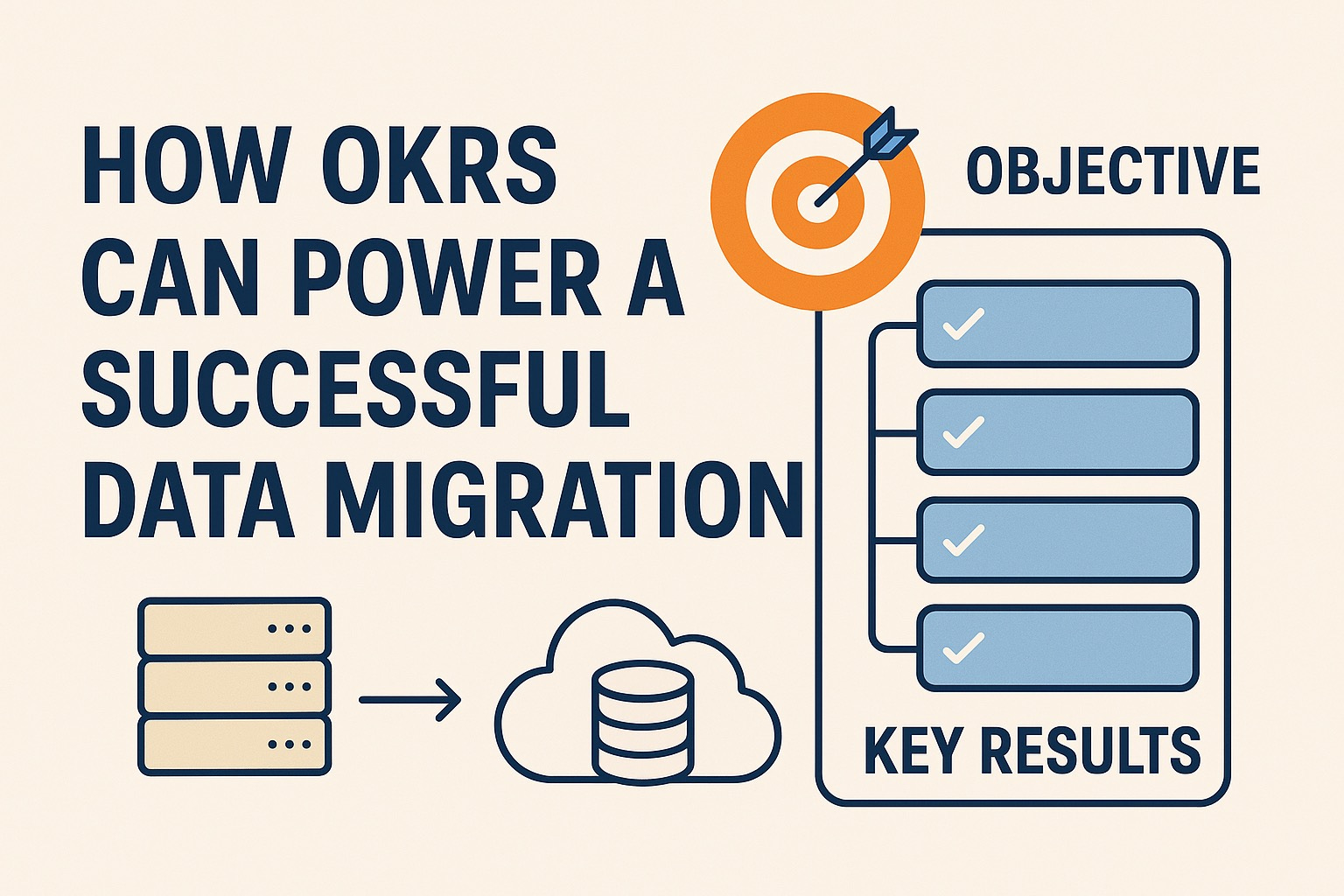
In today’s digital age, data is currency—and how we move that data can determine how fast and how well we grow. As organizations modernize, migrate to the cloud, or consolidate platforms, data migration becomes an unavoidable journey. But here’s the truth: most data migrations struggle not because of technology, but because of unclear direction and misaligned priorities.
This is where OKRs—Objectives and Key Results—can be a game-changer.
Why Data Migration Fails
Data migration isn’t just about moving rows from one table to another. It’s a high-stakes orchestration of systems, timelines, and trust. Migrations often fail due to:
Undefined business value.
Lack of clear milestones.
Poor cross-functional coordination.
Data loss or compromised integrity.
In other words, technical teams might move the data, but if the business doesn’t see the benefit—or if users can’t access it in time—it’s a loss.
Using OKRs to Bring Strategy to Execution
OKRs offer a simple yet powerful framework to align efforts across the organization.
✅
The Objective
Think of the Objective as the big “why.” For example:
“Successfully migrate legacy data to the new cloud platform with zero critical data loss and improved performance.”
This gives the project direction. It’s not just about completion—it’s about success.
📊
The Key Results
These are the tangible, measurable outcomes. For example:
Complete 100% of system data mapping and validation by August.
Migrate at least 95% of data with zero critical defects.
Reduce data latency by 30% after migration.
Gain governance and compliance sign-off before deployment.
Train all business users on the new system before go-live.
Each Key Result drives clarity, accountability, and measurable progress.
A Real-World Example
On a recent project, our team supported a major financial institution migrating from legacy on-prem systems to a cloud data platform (leveraging Snowflake). Instead of just moving data and checking boxes, we aligned OKRs across delivery, governance, security, and business operations. The result? A faster migration, fewer defects, and more trust from stakeholders.
OKRs helped the team focus not only on delivery but on value.
Final Thoughts
Data migration doesn’t have to be a chaotic backend operation. It can be a strategic milestone that propels your organization into the future. OKRs help you get there—not by adding complexity, but by clarifying the win and defining what success looks like.
As leaders, whether in tech, business, or governance, our job is to bridge the “what” with the “why.” OKRs do just that. They turn data migration into a growth moment—not just a project milestone.
Thanks for reading. If you found this helpful, feel free to subscribe for more insights on digital transformation, data strategy, and public innovation.
— Bus Obayomi