
K–12 Education Must Keep Pace with the Age of AI
Rethinking the Purpose of Education for the Next Generation

What is the purpose of K–12 education in the age of artificial intelligence?
It is a question I believe educators, parents, business leaders, universities, policymakers, and communities must begin asking together.
Artificial intelligence is transforming nearly every sector of society.
Healthcare is changing.
Business is changing.
Government is changing.
Manufacturing is changing.
The workforce is changing.
Higher education is changing.
The question is no longer whether AI will shape the future.
It already is.
The question is whether our K–12 education system is evolving at the same pace as the world our students are preparing to enter.
This is not a criticism of educators.
Teachers and school leaders continue to perform one of society’s most important responsibilities. Every day they inspire students, adapt to changing expectations, and prepare young people for an increasingly complex world.
The challenge is not one of commitment.
It is one of transformation.
Preparing Students for a World That Doesn’t Yet Exist
Many of today’s kindergarten students will graduate into careers that have not yet been created.
Artificial intelligence will become a collaborator in nearly every profession.
Students will not simply compete against technology.
They will work alongside it.
That reality requires us to rethink the purpose of education.
Perhaps the question is no longer simply:
“What should students know?”
Perhaps it is now:
“What kind of people should our schools develop?”
Knowledge will always matter.
But in the age of artificial intelligence, leadership, judgment, ethics, creativity, adaptability, and wisdom become equally essential.
The Four Pillars of Future-Ready Education
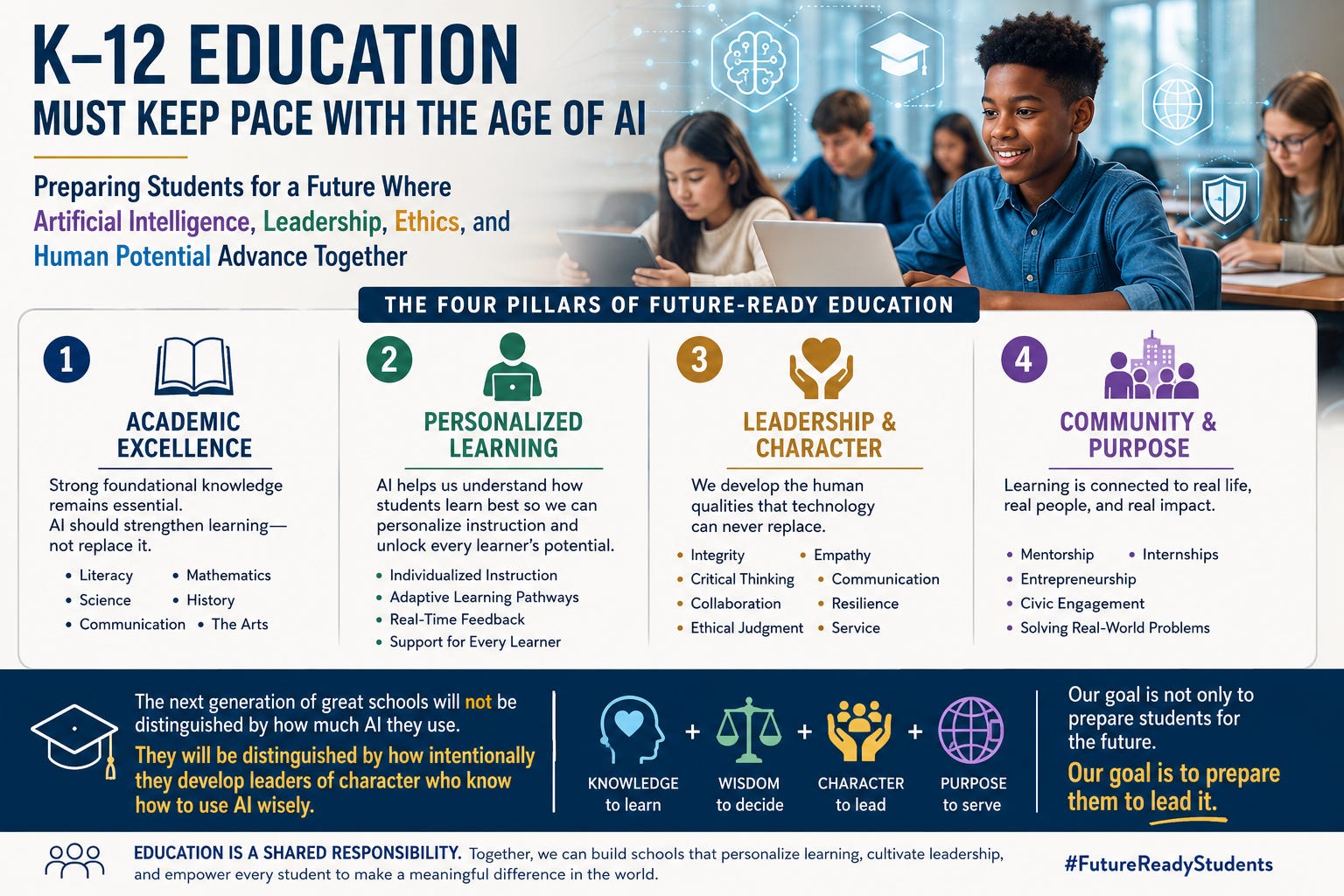
As we prepare students for the future, I believe K–12 education should intentionally develop four complementary pillars.
1. Academic Excellence
Strong foundations in literacy, mathematics, science, history, communication, and the arts remain indispensable.
AI should strengthen learning—not replace it.
2. Personalized Learning
Artificial intelligence provides an unprecedented opportunity to personalize education.
Students can receive individualized instruction, adaptive learning pathways, real-time feedback, and support aligned with their strengths, interests, and pace of learning.
For too long, education has often been built around standardization.
Students who learn differently are frequently defined by what they struggle with rather than by the unique strengths they possess.
Artificial intelligence gives us an opportunity to move beyond asking:
“How can students fit our educational model?”
and begin asking:
“How can education adapt to help every student flourish?”
Every learner is different.
Some require additional support.
Others need greater challenge.
The goal should never be to define students by labels or limitations.
The goal should be to understand how they learn best, recognize their unique gifts, and help every student reach his or her fullest potential with dignity and purpose.
3. Leadership & Character
As education becomes increasingly personalized, leadership, ethics, and character development must become even more intentional.
Technology can personalize instruction.
It cannot develop integrity.
It can generate information.
It cannot cultivate wisdom.
It can recommend solutions.
It cannot teach courage.
It can accelerate learning.
It cannot replace moral judgment.
Every student—not just those in student government, athletics, or advanced academic programs—should graduate prepared to lead.
Leadership should become an intentional outcome of every educational experience.
Students should leave school with the confidence to communicate effectively, collaborate across differences, solve meaningful problems, exercise ethical judgment, and serve their communities.
These are not “soft skills.”
They are enduring human capabilities that will become even more valuable as artificial intelligence becomes more powerful.
4. Community & Purpose
Education should not exist in isolation.
Students learn best when schools intentionally connect them with universities, businesses, nonprofit organizations, entrepreneurs, civic leaders, and community partners.
Learning should increasingly include mentorship, internships, entrepreneurship, service learning, and opportunities to solve real-world problems.
Education should prepare students not only for employment.
It should prepare them for leadership and meaningful contribution.
A Shared Responsibility
Preparing future-ready students is not the responsibility of schools alone.
It belongs to parents.
Educators.
Universities.
Businesses.
Faith communities.
Nonprofit organizations.
Government.
Communities.
Artificial intelligence gives us an opportunity to rethink not only what students learn, but how entire communities invest in developing the next generation of leaders.
The Opportunity Before Us
The next generation of great schools will not be distinguished by how much artificial intelligence they use.
They will be distinguished by how intentionally they develop leaders of character who know how to use artificial intelligence wisely.
The future of K–12 education is not simply integrating AI into classrooms.
It is integrating AI with leadership, ethics, personalized learning, character, community, and purpose.
Imagine every student graduating not only academically prepared, but also AI-literate, ethically grounded, emotionally intelligent, entrepreneurial, and committed to serving others.
Imagine classrooms where technology personalizes learning, while educators intentionally cultivate wisdom, integrity, compassion, and leadership.
If we get this right, we will do far more than prepare students for an AI-powered economy.
We will prepare a generation capable of leading it with wisdom, humility, innovation, and purpose.
That, in my view, is the future of K–12 education worth building.