

Every September 11, I remember the tragedy differently.
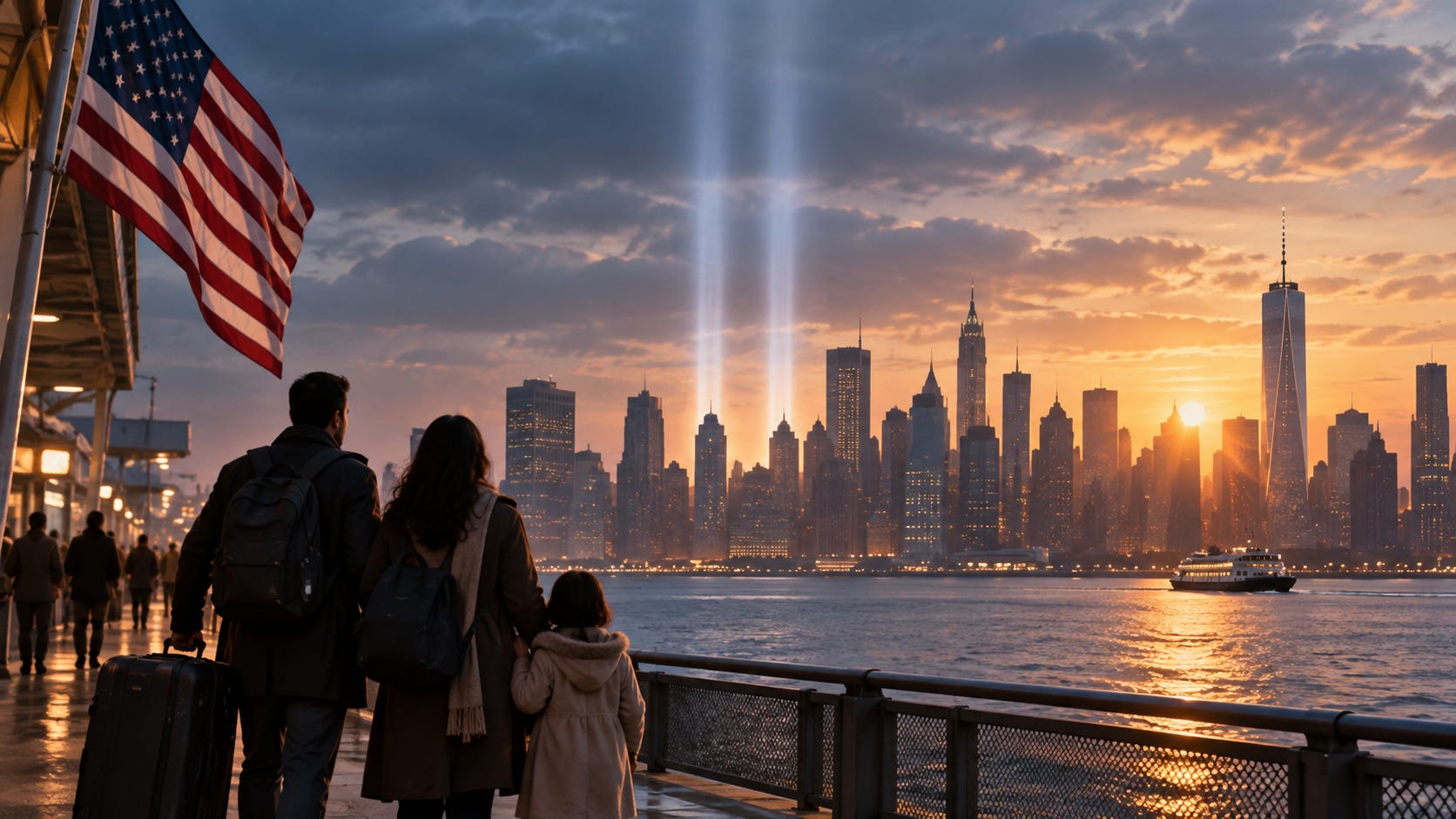
For me, 9/11 is not only a moment in American history. It is deeply connected to my own journey to America.
My parents had immigrated to the United States from Nigeria several years before my siblings and I joined them. My dad was an architect working just a few blocks from the World Trade Center. My mom worked at Harlem Hospital.
On the morning of September 11, 2001, we were still in Nigeria, preparing to move to the United States and finally reunite with our parents.
Then the news came.
We watched images of New York City that were almost impossible to comprehend. The Twin Towers were burning. People were running through the streets. The world seemed to be changing before our eyes.
And we could not reach our parents.
The phone networks were overwhelmed. Calls would not go through. For a period of time, my siblings and I did not know whether our parents were alive.
All we could think was: Have we lost them?
Thankfully, we eventually learned that they were safe.
But the fear of that day stayed with me.
Two months later, on November 11, 2001, my siblings and I boarded a plane for the United States.
Everything we had seen on television could have made anyone afraid to come to America. The news was filled with terrorism, destruction, grief, and uncertainty.
But our parents were here.
We needed to be reunited with them.
I still remember arriving at JFK Airport. I remember the coldness of New York and the heaviness in the atmosphere. The city felt somber. Wounded.
And yet, in the middle of all of that, there was the overwhelming joy of finally being reunited with my parents.
When I began high school in New York, September 11 was not something distant that students had simply watched on television.
Many of my classmates had seen it with their own eyes.
Students talked about looking through classroom windows and seeing smoke rising over the city. Some remembered watching the towers come down. Everyone seemed to know someone who had been affected.
But there was something else I witnessed in those early months in America.
I saw people come together.
Neighbors checked on one another. People asked my family whether we needed anything. Strangers showed compassion to strangers. First responders ran toward danger while everyone else was trying to escape it.
As a young immigrant trying to understand this new country, I remember thinking:
This must be the American spirit.
People came from different neighborhoods, backgrounds, races, religions, cultures, and political beliefs, but in that moment there was a recognition that we belonged to one another.
I also remember prayer.
Times Square Church, under the leadership of Pastor David Wilkerson, carried a tremendous burden to pray for New York City and for the nation. I remember gatherings of prayer and the unmistakable sense that our city and our country needed God.
That season became a pivotal point for me.
It helped shape how I understood America.
There is no single story of what it means to be American.
Some families have been here for generations. Others, like mine, came from somewhere else and found a place here.
But wherever our stories begin, we share a responsibility for what this country becomes.
We have a responsibility to care for our neighbors.
To defend the freedoms we have been entrusted with.
To pray for our nation and for those who lead us.
To serve our communities.
And perhaps most importantly, to never lose our humanity.
Twenty-five years later, I pray we never experience anything like September 11 again.
But I also find myself longing for something America experienced in the aftermath of that terrible day: the simple willingness of neighbors to care about one another.
People did not have to share the same background, politics, faith, or story to recognize each other’s humanity.
That is a lesson worth remembering.
Today, I remember the nearly 3,000 lives lost on September 11, 2001, and the families whose lives were forever changed.
I honor the firefighters, police officers, paramedics, healthcare workers, military members, and countless others who ran toward danger, and those who continue to serve our communities every day.
Their service allows someone like me to live safely with my family.
Twenty-five years ago, I was a young boy in Nigeria wondering whether my parents in New York were still alive.
Two months later, I stepped off a plane at JFK and began my own American story.
Today, I have the privilege of raising my family here, serving the community I love, and doing my part to leave this country stronger than I found it.
That opportunity is something I never take for granted.
My story is an immigrant story.
It is a New York story.
It is a story shaped by fear, faith, reunification, community, and hope.
And it is also an American story.
May we remember those we lost.
May we honor those who ran toward danger.
May we care for our neighbors, even when our stories are different.
May we pray for this nation and those entrusted with leading it.
And may we never lose the humanity that binds us together as Americans.
May we never forget.