
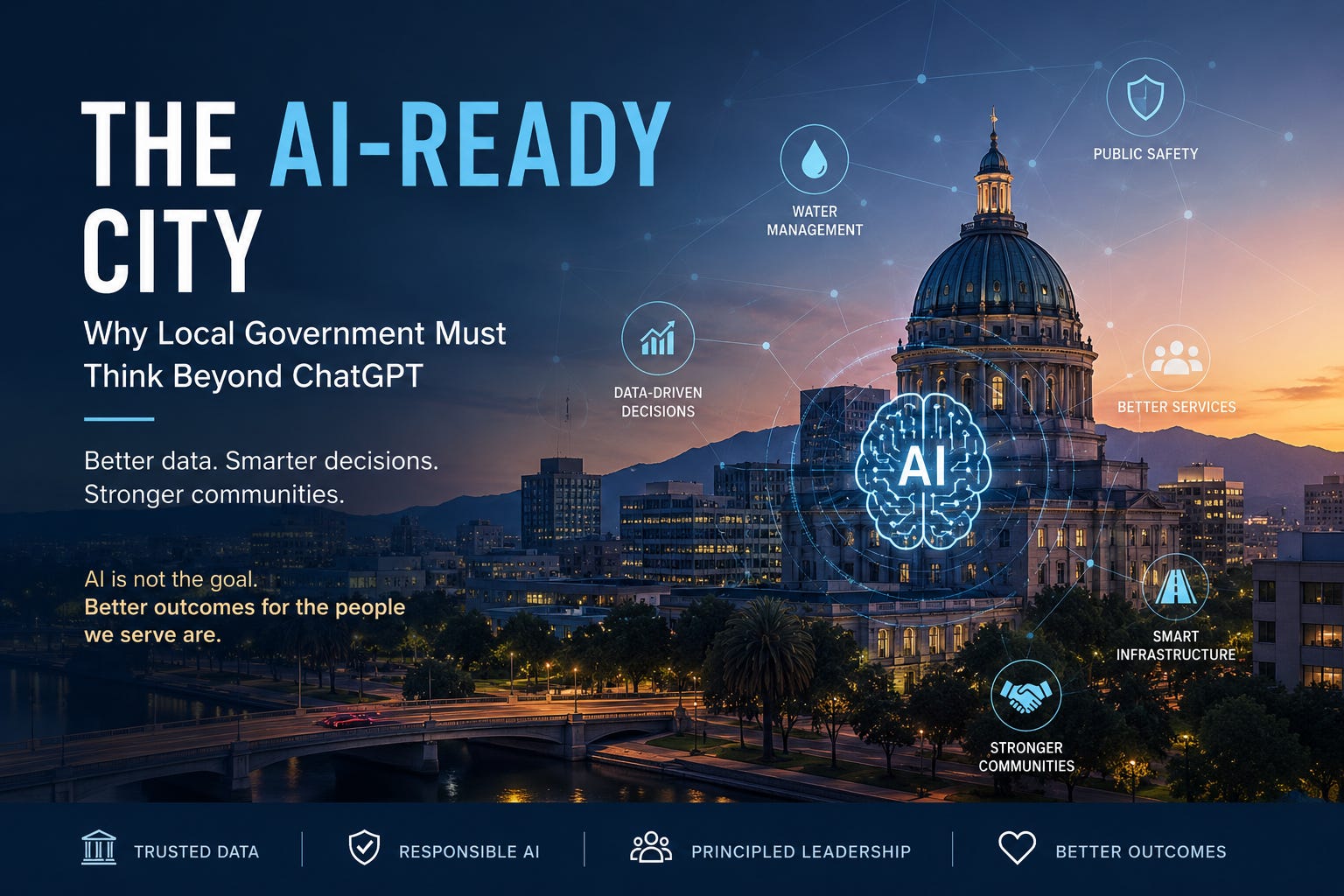
The AI-Ready City: Why Local Government Must Think Beyond ChatGPT
Artificial intelligence isn’t coming to local government—it has already arrived. The real question is whether our cities are ready.


Over the last few years, I’ve had the privilege of working at the intersection of strategy, data, and technology. My career has taken me through financial services, consulting, and AI transformation initiatives where I’ve seen organizations wrestle with one of the defining questions of our time:
How do we use artificial intelligence to create real value without compromising trust?
Today, I find myself asking that same question in a different context—local government.
As someone actively engaged in my community and passionate about public service, I’ve spent countless hours talking with residents, business owners, educators, nonprofit leaders, and public officials. The conversations are remarkably consistent.
People want safe neighborhoods.
Reliable infrastructure.
Affordable and sustainable water.
Efficient government services.
Responsible growth.
Strong local businesses.
A community that remains a great place to raise a family.
Interestingly, no one has ever told me they simply want “more AI.”
That’s because AI isn’t the goal.
Better outcomes are.
AI Is a Leadership Conversation
Too often, artificial intelligence is framed as a technology initiative.
It isn’t.
It’s a leadership initiative.
AI has the potential to help cities make better decisions, allocate resources more effectively, improve resident services, detect patterns that humans might miss, and reduce administrative burdens that consume valuable staff time.
Imagine if a city could:
Predict water demand before shortages occur.
Optimize traffic flow using real-time data.
Reduce permit review times while maintaining quality.
Identify infrastructure risks before failures happen.
Improve emergency response through predictive analytics.
Answer routine resident questions 24 hours a day while allowing employees to focus on higher-value work.
These aren’t futuristic concepts.
Many are already possible today.
But technology alone won’t make them successful.
Every AI Strategy Is Really a Data Strategy
One lesson has stayed with me throughout my career.
Organizations rarely fail because they lack AI.
They fail because they lack trusted data.
Artificial intelligence is only as good as the information it learns from.
If data is incomplete, inconsistent, outdated, or poorly governed, AI simply accelerates bad decisions.
That’s why I believe every city should ask these questions before purchasing its next AI solution:
Is our data accurate?
Do departments share information effectively?
Who is accountable for data quality?
How do we protect resident privacy?
How do we ensure transparency when AI influences decisions?
Are we solving a real community problem, or simply chasing the latest technology trend?
These questions aren’t technical.
They’re strategic.
The AI-Ready City
An AI-ready city isn’t defined by how many AI tools it owns.
It’s defined by its ability to use technology responsibly to improve people’s lives.
That starts with a strong foundation.
I think about AI readiness as a progression:
Leadership Vision → Community Outcomes → Business Processes → Trusted Data → Governance → Analytics → Artificial Intelligence → Continuous Improvement
Notice that AI comes near the end—not the beginning.
The most successful organizations I’ve worked with didn’t start by asking, “How can we use AI?”
They started by asking, “What problem are we trying to solve?”
Technology followed.
Building Public Trust
Perhaps the greatest challenge facing local government isn’t adopting AI.
It’s earning public trust while doing so.
Residents deserve to know:
How their data is being used.
Where AI supports decision-making.
Where humans remain accountable.
How bias is identified and mitigated.
How transparency is maintained.
Trust isn’t built through technology.
It’s built through leadership.
The communities that thrive in the AI era won’t necessarily be those that adopt technology the fastest.
They’ll be the ones that adopt it the wisest.
Why This Matters to Me
I’ve always believed my calling is to build bridges.
Bridges between business and government.
Between innovation and responsibility.
Between data and better decisions.
Between technology and people.
That’s why I’m launching this series.
In future articles, I’ll explore practical topics including:
What every city manager should know about AI.
AI use cases for public safety, water, and infrastructure.
Building an AI governance framework for local government.
Why data quality is the hidden competitive advantage for cities.
Preparing the next generation of public leaders for an AI-enabled world.
Artificial intelligence will shape the next generation of local government.
But technology alone won’t determine the future.
Leadership will.
The cities that invest in trusted data, thoughtful governance, and people-centered innovation won’t simply become smarter.
They’ll become stronger, more resilient, and better equipped to serve the communities that call them home.
Thank you for reading.
If you’re a public servant, city leader, technologist, educator, or simply someone passionate about the future of our communities, I’d love to hear your perspective.
What does an AI-ready city look like to you?