

Leadership Lessons from the Cave of Adullam
I have been meditating for a while on David’s journey—particularly his time in the Cave of Adullam.
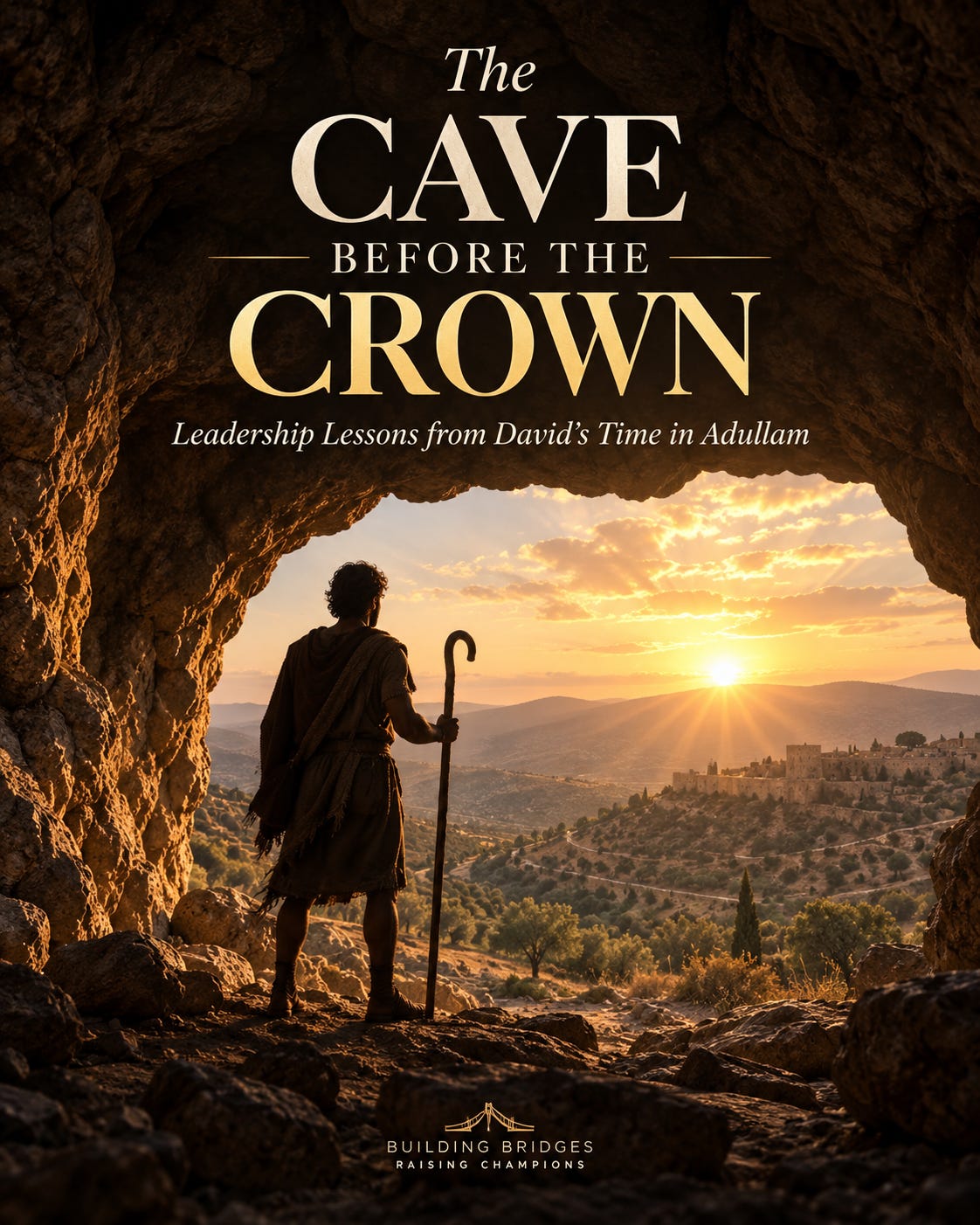
There is something deeply compelling about that season of his life.
Who was David when he entered the cave? What was he running from? What had he already experienced? And perhaps most importantly, who was he becoming while he was there?
We often celebrate David the king.
David the giant slayer.
David the warrior.
David the psalmist.
David the man after God’s own heart.
But before the throne, there was a cave.
Before the crown, there was formation.
Before David carried the responsibility of a nation, God took him through seasons that developed his character, deepened his spiritual life, expanded his leadership capacity, and taught him how to carry what was ahead.
The Cave of Adullam is therefore more than a geographical location in David’s story. I believe it represents something essential in our own holistic formation as leaders.
Anointed, But Not Yet Appointed
By the time David arrived at Adullam, he had already been anointed by Samuel.
He knew something significant had been spoken over his life.
He had already defeated Goliath. He had served in Saul’s palace. He had experienced recognition, military success, influence, and public admiration.
Yet in 1 Samuel 22, we find this same David hiding in a cave.
That tension is important.
David had the anointing, but he did not yet have the throne.
He had received the promise, but he had not yet entered its fullness.
There are seasons of leadership when you know what God has placed inside you, yet your circumstances appear completely disconnected from what you believe you have been called to become.
The temptation in such seasons is to believe something has gone wrong.
But perhaps not every cave represents failure.
Sometimes the cave is part of the curriculum.
There are things God develops in obscurity that cannot be developed under the lights.
The Cave Reveals Who You Are Without the Palace
David had spent time in Saul’s palace. He knew what proximity to power felt like.
But suddenly, the palace was gone.
Saul was trying to kill him.
The institution where David once served had become the very environment from which he had to flee.
And David had to discover something every leader eventually needs to understand:
Who am I when the institution is removed?
Who am I without the title?
Who am I without the platform?
Who am I when the people who once celebrated me no longer understand me?
Who am I when the doors that were once open suddenly close?
Leadership built primarily around position becomes fragile when position disappears.
Adullam stripped David of many external affirmations so that something deeper could be established within him.
The cave teaches us that identity must precede authority.
Because if we do not know who we are without power, power will eventually tell us who we are.
The Cave Forms Character Before Capacity Is Required
We often pray for greater influence.
Greater responsibility.
Greater platforms.
Greater opportunities.
But every increase in influence requires a corresponding increase in character.
David would eventually carry enormous authority. His decisions would affect armies, families, cities, and eventually an entire nation.
He could not simply be gifted enough to become king.
He had to become someone capable of carrying kingship.
Adullam was part of that preparation.
Leadership is not merely about whether we can reach a position. It is about whether our character can sustain us once we arrive there.
The cave exposes impatience.
It exposes insecurity.
It exposes ambition.
It exposes our relationship with recognition.
It exposes whether we are pursuing the assignment or simply pursuing the affirmation that comes with it.
And if we allow God to work in us, the cave begins replacing those things with patience, wisdom, humility, discernment, courage, and dependence upon Him.
The Cave Deepens Your Spiritual Life
David’s cave experiences were not merely leadership-development exercises.
They were spiritual encounters.
David prayed.
David cried.
David worshiped.
David wrestled with fear.
He learned what it meant to seek God when circumstances offered very little certainty.
Psalm 142 is identified as a prayer of David when he was in a cave. It is not the prayer of a man pretending that everything is fine. David acknowledges his distress and his sense of isolation, but he continues turning toward God.
There is a spiritual maturity that develops when God is no longer simply the One who gives you victory but becomes your refuge when victory has not yet arrived.
Some things about God are learned differently in the cave than they are in the palace.
The palace may teach you stewardship.
The battlefield may teach you courage.
But the cave teaches you dependence.
And every leader needs all three.
Your Adullam May Attract People You Did Not Expect
One of the most fascinating parts of David’s story happens after he arrives at Adullam.
People begin coming to him.
Scripture tells us that those who were distressed, in debt, and discontented gathered around David. About four hundred men eventually joined him, and David became their commander.
Think about that.
David was running for his life, yet people were looking to him for leadership.
He did not have a palace.
He did not have an official government.
He did not have institutional authority.
Yet leadership was already emerging.
Sometimes your leadership becomes clearest when there is no title available to validate it.
People came because there was something in David that they recognized.
And they were not necessarily the easiest people to lead.
They came with problems.
They came with frustration.
They came with baggage.
They came carrying the disappointment of their own stories.
And David had to lead them.
That is another lesson from Adullam: leadership capacity is often developed by leading imperfect people through imperfect circumstances.
Later, some of those associated with David would become extraordinary warriors.
The cave did not merely transform David.
It became a place where other people were transformed too.
That is leadership.
Do Not Become What Hurt You
Perhaps one of the greatest tests of David’s wilderness years was not whether he could survive Saul.
It was whether he would become Saul.
David would eventually receive opportunities to kill the very man trying to kill him.
It would have been easy to rationalize.
After all, had God not said David would become king?
Was Saul not standing in the way?
Would eliminating Saul not simply accelerate what God had already promised?
But David refused to manufacture his own fulfillment.
That is profound leadership.
Because one of the greatest dangers facing emerging leaders is allowing disappointment with the current system to corrupt the spirit with which they build the next one.
You may disagree with those currently holding authority.
You may have experienced disappointment from institutions.
You may clearly see what needs to change.
But Adullam asks:
Can you challenge what is wrong without becoming consumed by bitterness?
Can you disagree without becoming dishonorable?
Can you wait for the proper time rather than forcing your way into something God has already promised?
Can you inherit power without adopting the dysfunction of those who previously possessed it?
David had to learn how to carry authority before authority was placed in his hands.
The Cave Expands Capacity
There is another dimension of Adullam that I increasingly appreciate.
Capacity is not merely professional competence.
True leadership capacity is holistic.
It includes the ability to carry pressure.
To manage disappointment.
To discern motives.
To lead people different from yourself.
To make decisions without perfect information.
To wait.
To forgive.
To resist unnecessary battles.
To know when to move and when to remain still.
To maintain your spiritual life while carrying increasing responsibility.
These capacities are rarely developed in comfort.
They are developed through resistance.
That is why difficult seasons should not automatically be interpreted as wasted seasons.
You may be acquiring capacities today that you will desperately need tomorrow.
The Cave Is Not the Destination
There is also an important caution.
We should not romanticize Adullam.
David was not called to spend the rest of his life in a cave.
The cave served a purpose.
It was a place of refuge.
A place of gathering.
A place of prayer.
A place of leadership formation.
A place of preparation.
But eventually David had to leave.
Sometimes we become so accustomed to surviving that survival itself becomes our identity.
But leadership requires knowing when a season has completed its work.
There is a time for hiding and a time for stepping forward.
There is a time for preparation and a time for responsibility.
There is a time for Adullam and a time for Hebron.
Wisdom is recognizing the difference.
Between the Anointing and the Crown
Perhaps this is why David’s story continues to resonate with me.
Most leadership journeys contain an Adullam.
It is that strange space between what has been spoken and what has fully materialized.
You know you are no longer who you once were.
But you have not yet completely stepped into who you are becoming.
The old season has ended, but the new one has not fully taken shape.
That space can feel uncomfortable.
But it can also be sacred.
Because God is often doing His deepest work in the places that receive the least public attention.
Character is being formed.
Spiritual roots are growing deeper.
Discernment is developing.
Capacity is expanding.
Relationships are forming.
Motives are being purified.
And perhaps most importantly, we are learning that the calling was never merely about getting somewhere.
It was about becoming someone capable of faithfully carrying what awaits us when we arrive.
I increasingly believe that the Cave of Adullam is significant in our holistic formation.
It is the formation of character.
It is spiritual growth.
It is leadership development.
It is capacity building.
It is where ambition can become stewardship.
Where gifting can become maturity.
Where calling begins to carry weight.
David entered the wilderness as an anointed young man running from Saul.
He would eventually emerge as a leader capable of gathering people, commanding men, navigating complexity, exercising restraint, and ultimately carrying the responsibility of a kingdom.
The cave did not give David his calling.
God had already done that.
The cave helped prepare David to carry it.
And perhaps that should change the way we look at our own caves.
Not every hidden season means we have been forgotten.
Not every closed door means the promise has disappeared.
Not every uncomfortable transition means we are moving backward.
Sometimes the cave is where God is quietly expanding us for what comes next.
So perhaps the prayer for our Adullam seasons should not simply be, “God, get me out of here.”
Perhaps it should also be:
“Lord, do not allow me to leave this season without becoming everything You intended to form in me while I was here.”
Because before the crown, there may be a cave.
And sometimes the cave is exactly what prepares us to carry the crown.