

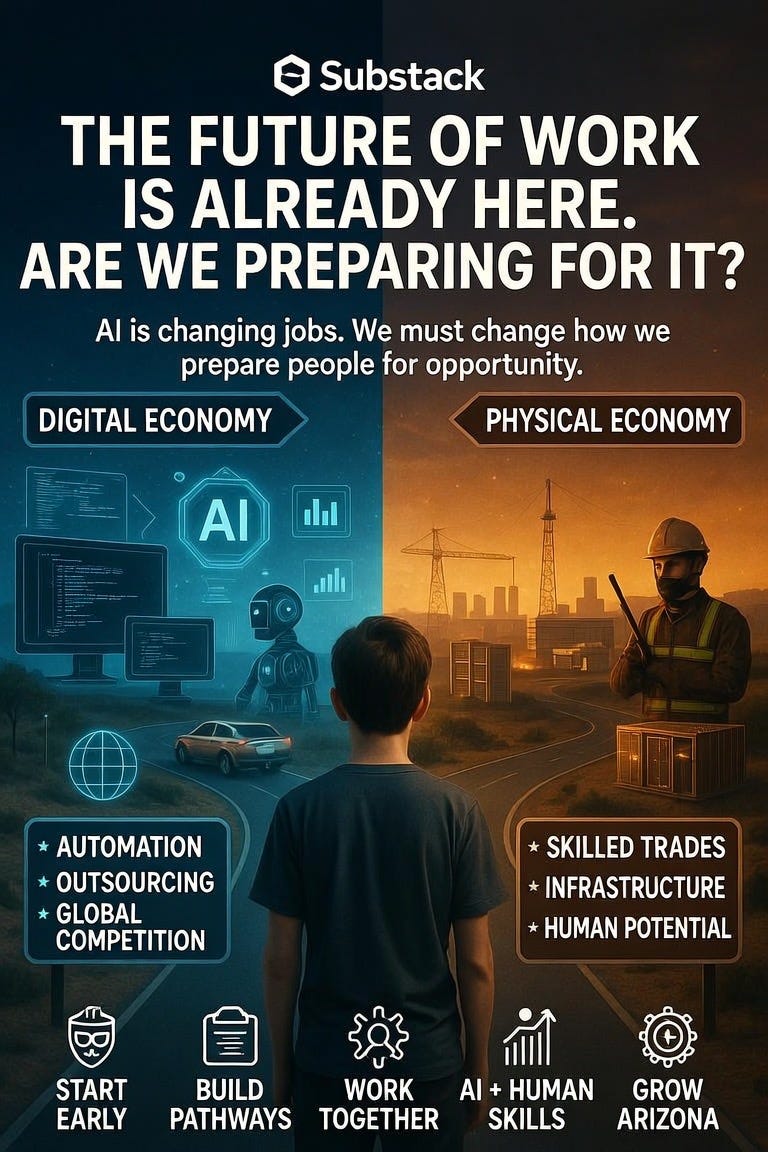
I think a lot about the future of work.
Not simply what jobs will exist next year, but what opportunity will look like five years from now. Ten years from now.
What will a student graduating from high school today encounter when they enter the workforce? What will happen to the college freshman choosing a major based on what the job market looked like five years ago?
And perhaps most importantly for those of us entrusted with leadership:
How do we position our communities and our state to compete in an economy being fundamentally reshaped before our eyes?
This is not a fable.
This is not something coming someday.
This is happening now.
After nearly two decades working in technology and the private sector, I see two major forces converging.
First, more tasks that once required specialized technical knowledge can now be automated, accelerated, or augmented by artificial intelligence.
Second, work that can be performed digitally can increasingly be performed anywhere in the world.
That fundamentally changes the competitive environment.
A student graduating from Arizona State University, the University of Arizona, Northern Arizona University, Grand Canyon University, a community college, or another institution is no longer simply competing against the person sitting next to them in class.
They may be competing against someone in Phoenix, New York, Lagos, Bangalore, Manila, Warsaw, or Buenos Aires.
And increasingly, they are also competing against software capable of performing portions of the work itself.
That is not an easy conversation to have.
But refusing to have it will not change the reality.
The Career Ladder Is Changing
For generations, there was an understood pathway into many professional careers.
You went to school.
You earned the credential.
A company hired you into an entry-level position.
You made mistakes.
Someone more experienced reviewed your work.
You learned.
You developed judgment.
Eventually, you became the person reviewing someone else’s work.
In many ways, corporate America operated its own informal apprenticeship system.
That system is now under pressure.
Some of the very tasks historically assigned to junior employees—research, basic coding, documentation, financial analysis, presentation development, data processing, first drafts, customer support, and administrative work—are increasingly tasks that AI can assist with or perform.
That raises a question I believe deserves far more attention:
If technology performs more of the beginner-level work, where do beginners learn how to become experts?
This may prove to be one of the most consequential workforce questions of the AI era.
The disruption may not happen through dramatic mass layoffs.
It may happen more quietly.
A company hires six entry-level analysts instead of twelve.
A software team hires three junior developers instead of eight.
An experienced employee equipped with AI produces work that previously required several people.
Multiply those decisions across thousands of organizations, and the bottom rungs of the career ladder begin to disappear.
That matters because entry-level work was never only about productivity.
It was where people learned.
It was where people failed with relatively low consequences.
It was where they developed judgment, confidence, professional relationships, and institutional knowledge.
If that apprenticeship function is shrinking, we cannot simply hope something else replaces it.
We have to intentionally rebuild it.
At the Same Time, the Physical Economy Still Needs People
There is another side to this transformation.
While some knowledge-work tasks can increasingly be automated or performed globally, many jobs connected to the physical world remain difficult to automate and increasingly valuable.
Electricians are a good example.
The U.S. Bureau of Labor Statistics projects electrician employment to grow faster than the average for all occupations over the next decade, with tens of thousands of openings expected annually.
And that makes sense when we look at where the economy is heading.
Data centers need power.
Semiconductor facilities need power.
Advanced manufacturing needs power.
Housing needs power.
Electric vehicles need charging infrastructure.
Artificial intelligence itself depends on enormous physical infrastructure—energy generation, transmission, cooling, construction, and maintenance.
The irony of the AI revolution may be that some of the strongest opportunities it creates will not involve sitting behind a computer writing code.
They may involve building and maintaining the infrastructure that makes the digital economy possible.
That should change how we talk to young people about success.
A four-year university degree can be extraordinarily valuable.
So can an apprenticeship.
So can a skilled trade.
So can a community-college credential.
So can a technical certification.
So can entrepreneurship.
The question should no longer simply be:
“Where are you going to college?”
A better question is:
“What capabilities are you developing that the economy will value?”
Education Has to Change With the Economy
This conversation cannot begin when someone reaches college.
It has to begin much earlier.
For too long, we have treated K–12, higher education, workforce development, and economic development as separate systems.
K–12 prepares students for college.
College prepares students for careers.
Employers hire graduates.
Economic-development organizations recruit companies.
Each institution does its part, but often within its own lane.
The future requires something much more integrated.
I believe we need to think about K–12 education, higher education, community colleges, workforce development, employers, apprenticeships, and economic development as one collaborative talent ecosystem.
Students need earlier exposure to the economy they are preparing to enter.
That means exposure to AI.
But not only AI.
Students should encounter skilled trades, engineering, healthcare, advanced manufacturing, entrepreneurship, cybersecurity, construction, public service, and emerging industries long before they make expensive decisions about their education.
We also need stronger bridges between classrooms and workplaces.
Internships.
Apprenticeships.
Job shadowing.
Industry certifications.
Dual enrollment.
Project-based learning.
Mentorship.
Real problems from real organizations.
Real exposure to employers.
Real opportunities to fail, learn, and improve.
Education cannot simply be about transferring information anymore.
Information is increasingly abundant.
The premium will increasingly be on what a person can do with information.
Can you think critically?
Can you solve an ambiguous problem?
Can you communicate?
Can you work with people?
Can you exercise judgment?
Can you lead?
Can you build?
Can you understand a customer, resident, patient, or employer’s need?
Can you combine technical capability with human understanding?
The answer to the future of work is not simply:
Teach everyone AI.
The better answer is:
Develop people who know how to work with AI while bringing distinctly human capabilities to the table.
Arizona Has a Choice
This conversation matters enormously for Arizona.
Our state is competing in semiconductors, advanced manufacturing, aerospace, healthcare, bioscience, energy, data infrastructure, and technology.
But economic development cannot simply mean celebrating the next major company that announces a facility.
We have to ask a deeper question:
Are we merely attracting capital, or are we building Arizonans who can participate in the prosperity that capital creates?
That distinction matters.
If we recruit the industries of the future but do not prepare our own residents to participate in them, we will have accomplished only part of the job.
Workforce development therefore cannot be an afterthought to economic development.
It has to be part of the strategy from the beginning.
When we discuss attracting a semiconductor facility, we should also be discussing technicians, engineers, electricians, construction workers, suppliers, cybersecurity professionals, managers, and educators.
When we discuss data centers and artificial intelligence, we should also be discussing power generation, utilities, skilled trades, cooling infrastructure, and technical education.
When we discuss advanced manufacturing, we should be asking what students need to begin learning today so they are prepared for those opportunities tomorrow.
Cities and towns have a role.
School districts have a role.
Community colleges have a role.
Universities have a role.
Employers have a role.
The state has a role.
Parents have a role.
And ultimately, we need to work backward from the future we want.
Which industries do we want Arizona to lead over the next 10 to 20 years?
What occupations will those industries create?
What competencies will workers need?
Where will they develop those competencies?
And how early should we begin exposing young people to those opportunities?
That is workforce development.
That is education policy.
And increasingly, that is economic-development strategy.
We Cannot Lead From the Sidelines
As someone who comes from technology and the private sector and now has the opportunity to serve in elected public leadership, I think about this responsibility frequently.
Government should not attempt to predict every job of the future.
We will get some predictions wrong.
Nor should government attempt to engineer everyone’s career.
But public leadership can help create the conditions that allow people to adapt, learn, build businesses, develop skills, and participate in emerging industries.
And this is where fiscal responsibility and long-term thinking have to coexist.
We should absolutely be responsible stewards of taxpayer dollars.
But stewardship is not simply about what we save today.
It is also about whether we are preparing our communities for tomorrow.
There is an evolution taking place.
AI will create extraordinary opportunities.
It will also disrupt jobs, business models, and career pathways that many of us assumed would remain relatively stable.
We should neither fear that reality nor romanticize it.
We should prepare for it.
Five Things We Should Do Now
Start career and workforce exposure earlier.
K–12 students should encounter technology, skilled trades, healthcare, advanced manufacturing, entrepreneurship, and other high-demand fields well before graduation.Rebuild the apprenticeship pathway.
If traditional entry-level corporate work is shrinking, we need more internships, apprenticeships, mentorships, job shadowing, project-based learning, and employer partnerships where young people can develop real-world judgment.Integrate K–12, higher education, and employers.
Schools, community colleges, universities, employers, workforce organizations, and local governments should operate as a connected talent ecosystem rather than independent institutions.Develop AI capability and human capability together.
Students and workers need AI literacy, but they also need communication, leadership, creativity, critical thinking, adaptability, collaboration, and problem-solving—the capabilities that become more valuable as technology improves.Make talent development part of economic-development strategy.
When Arizona recruits industries of the future, we should simultaneously build the workforce pathways that allow Arizonans to fill those jobs, create businesses around them, and participate in the prosperity they generate.
The question is no longer whether AI will change the workforce.
It already is.
The question is whether our education systems, employers, communities, and public institutions will evolve quickly enough with it.
The future of work will not wait for us to be ready.
We can shape it.
We can prepare for it.
We can compete for it.
Or we can arrive after the decisions have already been made.
For Gilbert and for Arizona, I believe we should lead.


